Categories
Diversity Work place

Diversity in the workplace: An interview with jeweller Ditebogo Sesana

Diversity is important in any workplace and it means more than just making sure different genders, cultures and races are represented. Encouraging an organisational culture that is accepting of everyone, where each person feels valued enough to contribute, is a fundamental part of good business management.

Disability does not mean a lack of ability to perform in a role; instead it’s an opportunity for differently-abled individuals to learn skills, add value, and empower themselves in an integrated workplace environment towards a common goal.

I spoke to Ditebogo Sesana; a Deaf jeweller and a good friend of mine of nearly 10 years. We first met in Lenasia while he was learning about the industry, and I was his novice interpreter. Today he proudly works full-time in a reputable jewellery company, applying all the knowledge acquired over the years. His support and often brutal feedback has contributed to my successful journey as a professional interpreter.

1) Tell us more about yourself and what you do.

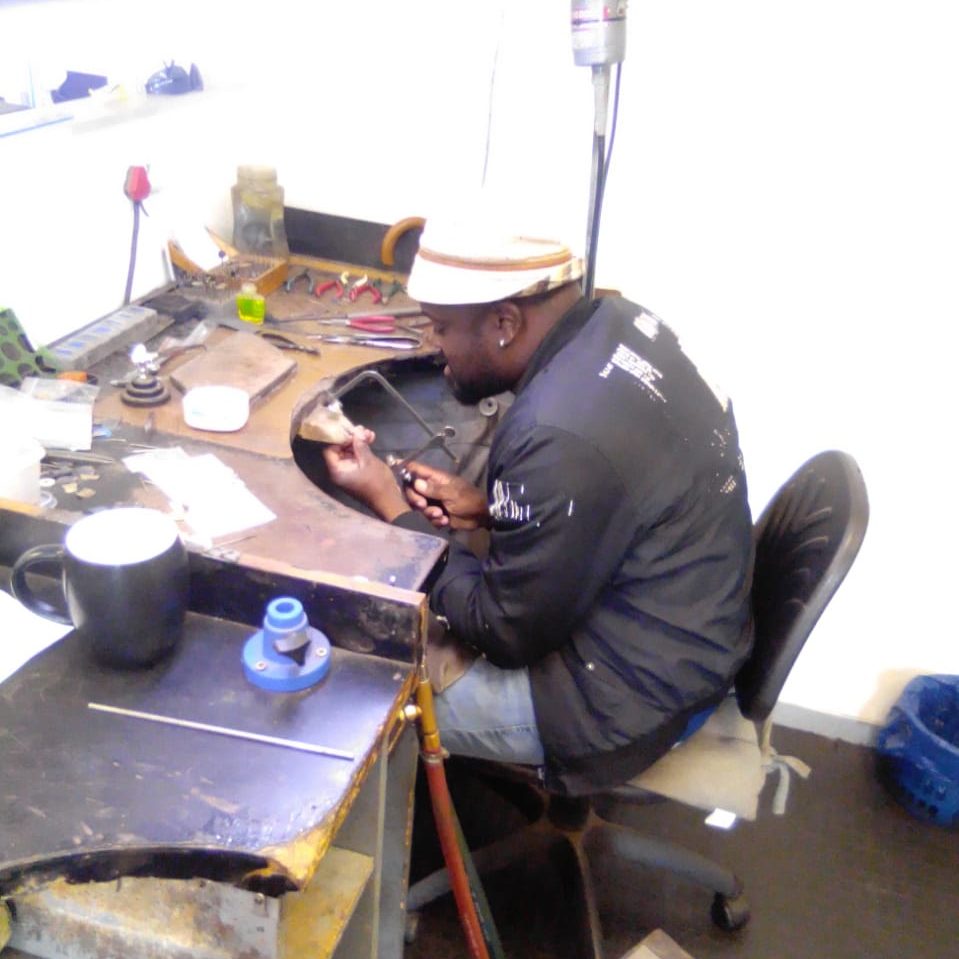
I’m from Pretoria, Soshanguve but currently live in Alexandra. I’m a triplet with my brothers and the only Deaf person in my family. My hobbies include playing soccer and spending time with friends. I work at Rare Earth Creations in Randburg; I create, polish and set different jewellry pieces. I’ve been employed here for 8 years and I’m the only Deaf person in the company.

2) How do you communicate with your Team?

We write everything on pen and paper. Our communication is work related and we only discuss instructions needed about jewellery pieces. My literacy skills enable me to understand what is expected of me and I also express any ideas, questions or concerns in writing if I need to.

3) Why is there no SASL interpreter at the workplace?

I’m the only Deaf person here at the company, so to have an interpreter just for one person is not viable. Unfortunately, management also doesn’t have the budget to employ an interpreter at the company. The written communication seems to work well for everyone and I’ve learned to adapt well to the working environment. The Team is satisfied with my performance.

4) Can Deaf and Hearing people work together in the same environment?

Absolutely! There is no difference between us because we can perform and complete the task – sometimes better than our hearing colleagues. What’s important is respect, a good attitude and willingness to learn about people from different backgrounds. Teamwork helps us to work together and focus on the task at hand.

5) Do you think more people with disability should be employed as jewellers?

Yes, we are equally skilled as anyone else. What matters is doing a good job and completing the task; people should learn to embrace differences and keep an open mind in the workplace – then it will be easy to build lasting relationships based on respect. For now, I am the only Deaf person working here – hopefully this changes.

Andrew Greenberg, founder of Contract Recruiter, explains some benefits of employing Deaf and HH employees:

Attention to detail

Jewellery making is very intricate; and it requires much attention to small details that affect the look and feel of the product. Deaf people usually have superior visual ability and hand-eye co ordination needed for handling delicate stones.

Loyalty

The barriers of employment are high for people living with disability due to inaccessible environments, lack of awareness from the employer, and sometimes misconceptions about the type of disability. As a result, when they do find suitable employment, they tend to stay longer because they value the opportunity given to them to earn a living and become independent.

A unique perspective into the workplace

From communication, accessibility, and even culture – people with disability are often vocal about recommending better ways of embracing diversity in the workplace. They challenge the Team to respect differences and overcome any false stereotypes about disability. This approach creates a colourful and vibrant workplace.

Conclusion

Diversity is an attitude we hold towards a certain idea or a group of people which reveals itself in the systems we create in spaces. When truly embraced, an incredible opportunity arises to empower everyone through knowledge and acceptance.

Ditebogo is a great example of how one can use their skills and passion to create a better life for themselves. Being Deaf has not stopped him from achieving his goals, instead it has inspired others to work hard and believe that anything is possible. I’m excited about his future success!

Categories
Anniversary Celebration One Year Later Small Wins

The Power of Progress: One Year Later.

As we celebrate the first year anniversary of Yellow Owl’s existence, we reflect on our journey and celebrate the small wins. Progress is a powerful motivator to drive inspiration, even when setbacks happen.

I recently read an article published by Harvard Business Review explaining that acknowledgment of the best and the worst days are central to innovation in any creative environment. Emotions run high when things go according to plan: excitement, joy, happiness, satisfaction and validation. But the same is true when we hit a dead end: self-doubt, frustration, darkness, worry and temptation to quit. It’s all part of the journey.

The progress principle highlights that true motivation lies in ordinary everyday wins – we should try and find at least one thing to celebrate, an achievement, a victory lap, a tick on the to-do list. Some of Yellow Owl’s greatest moments over the passed year include taking the bold step to register the business and putting ourselves out there, particularly online for everyone to see.

Another proud moment has been collaborating and pioneering with leading brands, organisations and content creators like CliffCentral.com, Mav Inc., The Mayors Office & Lionesses of Africa to make valuable information more inclusive using SASL interpreting. There’s so much to be grateful for!

Equally discouraging has been the rejection from incredible digital platforms who unfortunately can’t see possibility beyond their own fears and rigid business model. Nothing happens over night, and patience is one painful trait that gets better with time – just wait, it will come. Sometimes failure and setbacks are not always a true reflection of the value we offer – sometimes it’s other people who don’t understand the bigger vision, they just don’t get it.

Some helpful tips to keep you going when the going gets tough: surround yourself with supportive, accountable and positive people. Secondly, remember your WHY – very important when it feels like you are losing direction. Lastly, create practical deadlines and timelines to keep track of progress made.

THANK YOU to everyone who believed and continues to invest in the vision of Yellow Owl. Here’s to more extraordinary interpreted stories, pioneering, and collaborations. Onwards and upwards!

Categories
Branding Interpreting Personal Development

Why interpreters should think and act like a brand.

BrandSimple is a book I highly recommend for any individual or company that would like to be recognised as a successful brand. Everyone is a brand – the key is to start thinking and acting like one. Allen P. Adamson – the author, explains how the best brands keep it simple, and as a result enjoy huge success.

Earlier this year, I re-visited the main ideas of the book and felt inspired to share my practical insights on what I understand a brand to be; and why every individual or organisation should start thinking and acting like a brand – regardless of the industry and the size of the business. The research that I continuously dig up about branding is quite fascinating; all the authors, bloggers, and experts emphasise the same thing: that a brand is more of an experience rather than something we can touch and see. Its driving force is psychological and decisions are made by consumers unconsciously.

With this premise in mind; I would like to apply some fundamental principles to the interpreting industry, first as an individual followed by a business; and hopefully encourage readers to start establishing their own brands.

What is a brand?

A brand is often misunderstood and reduced to the visual elements that make up the brand, such as the logo, colours, shapes and the clothes worn. In fact, branding specialists Ignyte explain that a brand is a mental process of identifying emotions and actions that shape the perception in a person’s mind; it’s a memorable impression created in a consumer’s mind – both positive and negative.

The way that people perceive you as an individual has a huge impact on your reputation – your body language, the words you use, how you engage with others – people are constantly paying attention and making mental notes. So branding, personal or business branding, keeps evolving because you can decide who you want to be known for; and by strategically positioning yourself, you can change and control how stakeholders engage with your brand – this ultimately influences your reputation.

Thuli Zikalala is my personal brand. Yellow Owl is my SASL interpreting brand.

Here are three tips on WHY branding is so important, taken from Forbes.com

1) It distinguishes you from your competition

Your brand allows consumers and stakeholders to know exactly what to expect from you or your business. This is where you communicate specific elements such as your personality, values, purpose, mission – and by using branding road map tools, you are able to direct and measure overall progress. I’m passionate about leadership and driving positive change in my community – I want to be known and remembered for this.

Expressing your shared values and ideas is a powerful way to set yourself apart from your competitors because there is something familiar that audiences can resonate with; which influences them to choose you over someone else. Yellow Owl drives the message of making digital content refreshing, accessible and inclusive to a wider audience through SASL interpreting and captioning – we want to capture the users’ online experience.

2) It drives new business and increases your brand value

Your reputation always precedes you. There is an uncontrollable ripple effect, almost like a chain reaction when people mention your name or business. Word of mouth is also a form of advertising because people may refer your business based on the positive or negative impression they had when engaging you.

The good thing is that if stakeholders perceive you to be reliable and familiar; then new potential clients may find you because of already existing positive mental associations about you – keeping you one step ahead of your competitors!

3) It builds trust

In a world that is constantly changing; we keep looking for meaning, belonging, identity and purpose wherever we can find it. The best way to retain stakeholders in your company is to deliver on the promises you make; an this is the difference between intent and action – if customers will buy your products and actually buying your product.

But HOW do you build a successful brand?

Brand building experts Freshsparks tells us how:

1) Discover your brand voice

A brand voice includes elements that distinguish your company from competition advantage that’s easy for people to recognise. Examples of this are your brand story, logo, website, colours and taglines, mission and values. It is important to understand your passion and what you want to be remembered for – what positive impact would you like to make in society.

2) Always deliver on your promise

When you as a person or your business says it will do certain things or provide a certain experience; these are found in your messaging, tagline, launch dates. The expectation created is much higher when the promises are explicit and tangible. On the other hand, subtle promises are more achievable because consumers have more time to process branding signals unconsciously.

3) Persevere and be patient

One of the hardest reality checks is that success does not come over night; it takes a lot of work, consistency and practice. As mentioned in the beginning, establishing a successful brand is multi-layered that includes psychology, philosophy, art and science that continues to evolve over time in structure, experience and meaning.

Conclusion

When I started thinking of myself as a personal brand and being intentional in my business to communicate my vision, purpose and mission – my life changed. I became more focused and strategic about how I spend my time and who I surround myself with, like-minded people who share my ideas.

I would encourage readers and interpreters to be aware that everything they say and do is being watched and ultimately communicates a certain message that may be perceived as pleasant or uncomfortable. If you are currently unsure about how people perceive you, or you know for sure that your reputation is not that good: make a honest introspection about what you want to be known for and start moving into that direction through everything you so and say.

Before long, after some effort, you should see be on your way to building and developing your personal and business brand.

Categories
Be Different Interpreting Unique Ability

How to discover your unique abilities

Dare to be different!

Discovering your unique abilities is one of the most liberating experiences. It never feels like hard work and exciting opportunities of making a positive impact in society keep unfolding. Through self-awareness and introspection of who I am as a person first; l am able to apply the same intrinsic truths across every area of my life – including my career.

Now, this is not to say that I am the only skilled interpreter around – in fact, there are better interpreters out there who’ve been doing this way longer. The point I’m trying to drive home is firstly; how to identify your unique traits within a saturated industry; then using the same qualities to help you stand out from the crowd.

Here are three tips on how to identify your often overlooked unique abilities.

1) Lifelong habits and behaviours

Look for and pay attention to preferences, habits, and behaviours that have consistently shown up since childhood. These affect your outlook on life and how you engage with the people around you.

I’ve always enjoyed smaller, more intimate groups because they feel personal and loyal. When I’m not alone processing my thoughts; I often find myself with one or two trusted people in my personal space, whether friends or family. 

Looking back, this guarded introverted approach has definitely influenced how I choose my interpreting projects and clients. Today, I offer exclusive interpreting services to three individual clients, who over the years have become trusted friends. Secondly, I prefer to collaborate with smaller, independent  organisations because that encourage full participation in the decision-making process.

2) It comes so naturally, it often doesn’t feel special

We have a tendency to take our unique abilities for granted because we’ve always done things this way; it no longer feels flashy or exciting. Maybe you can solve problems easily, you have an eye for intricate detail, you’re a natural leader, or you’re an entertaining storyteller.

These clues come up in areas where your execution is effortless for you, but somehow seems difficult for others doing the same task.

I have a good memory and I can retain large volumes of information mentally for a long time. Reading, research, decoding information, and having a vivid imagination come naturally to me. I enjoy engaging with content that enhances my cognitive stimulation. 

Whether it’s interpreting a keynote address, or a training session, or even ‘reading’ the emotions in a room; interpreters use both their left and right brain for language, judgement, visualisation and creativity. 

3) You show up as the hero

What things do other people always count on you for?

Are you punctual? Do you always keep your word and do what you say you’ll do? Perhaps you have a positive attitude that uplifts everyone else.
The ways that you positively impact people are the things they’ll consistently come to you for; it’s also how you show up as a hero in.

I am known for making things happen – people often delegate me a leadership role that requires planning, effective communication and assertiveness.

Having established your unique traits across different areas of your life; here are three more reasons why interpreters should dare to be different.

1) It’s noisy and everyone is shouting

Although the interpreting industry is fairly unknown to most; my observation is that the opportunities and platforms that do already exist follow traditional ways of communicating information created by somebody else. Whether it’s interpreting on settings such as TV, training or even social circles – everyone seems to blend in and follow what’s been done before.

2) You can’t be a distinguished leader by following others

I’ve always had a deep desire to be at the forefront of change; I always look around and ask myself ‘How can things be done better?’ Interpreting enables me to offer solutions to societal challenges that focus mainly on bridging communication, empowering people, and using technology to innovate exciting ways remove barriers.

Being an entrepreneur and exploring opportunities of collaboration through digital platforms is one way I intend to forge my own path and leave a long-lasting mark in the industry.

3) Great people make things happen – they don’t ask for permission

I honestly don’t think I’d be at this very moment in my life had I waited for someone or something to validate my purpose. My experiences so far have taught me that I am responsible for the way other people treat me – If I value, believe, and trust in myself, then like-minded people often show up in my life at the right time.

As an interpreter, I see many gaps that need to be filled in the way content and information is delivered. We have a long way to go! I have decided to be bold, take charge, and continue to align my daily actions to my bigger vision of driving positive change in our communities through creativity, collaboration, and mastery.

Conclusion

Decide who you want to be and what you want to be remembered for; and often those around adjust. Standing out from the crowd begins with acceptance of the mission laid out in front of you – something that only you can do. Once you discover your unique offering to the world; it’s easier to celebrate people’s successes because you understand there are plenty of opportunities for us all.

Categories
Accreditation Career Interpreting Personal Development

To SATI, or not to SATI?

Stamp of Approval

Would you trust a doctor without a practicing licence to help you when feeling sick? Would you sit down and eat the food prepared by a restaurant that is not licenced? Absolutely not! My health and wellness are way too important both for me and my loved ones, to risk food poisoning or even worse – death. The same principle applies to practicing interpreters: as an individual or organisation; I would be very skeptical approaching an interpreter that has no accreditation for my important meeting, and ultimately risk miscommunication and a tarnished reputation.

Each industry has authority bodies that regulate practices and protect the interests of individuals, communities, and organisations. This is to ensure that work is done at a level that meets or exceeds expectations developed in that specific industry. For example, the HPCSA (Health Professions Council of South Africa) is the statutory body in the medical industry that regulates professional services offered by health workers in South Africa. The CGCSA (Consumer Goods Council of South Africa) advocates for food safety and food waste best practices across the retail industry.

For us interpreters, this institute is SATI.

Who is SATI?

The South African Translators’ Institute (SATI) is a professional association for language practitioners in South Africa; ranging from translators, text editors, interpreters, lexicographers, proofreaders, and copywriters. A system of accreditation was introduced in 1990 aimed at improving the standing of language practitioners; maintain a high level of competence; and adherence to a strict code of ethics. The system began with translation and has since expanded into other related language services.

Failure is not final

In 2017, I failed my first attempt at getting accredited. I gave it my best shot and felt devastated to learn that I failed the exam. Honestly, the exam criteria is difficult – it tests all the skills needed for language practitioners to serve and thrive in a competitive industry. Furthermore; overcoming difficulty ensures a high standard of competence needed for real-life, often stressful working environments.

Fortunately, through determination and support; I re-applied in 2018 and passed the exam. There are currently only 12* SATI accredited SASL interpreters in South Africa; hopefully this number grows over time. (*Number updated accordingly).

3 Benefits of SATI membership

  1. Ensure best practice

Being a member of a recognised association helps individuals comply with ethical requirements of their industry and maintain a high quality service. As an interpreter; being a member of SATI helps me stay accountable to fellow interpreters who look up to me; I am responsible to conduct myself professionally and ethically at all times being fully aware how my decisions may impact generations to come – positively or negatively.

2. Peace of mind regarding competence

The most rewarding feeling I get when working with clients is the re-assurance of getting the job done, very well – I can deliver on the promise to always give my best. Displaying competence is a great way to build credibility, trust, and respect with clients, while giving them a peace of mind to focus on the task at hand.

3. Networking opportunities

SATI hosts regular webinars, workshops and training; and as a member I have access to this information because I am on their database system. I receive weekly emails circulating updates of job opportunities, news of other language practitioners, and connecting with fellow professionals. It’s a great way to network and learn from other related language industries.

Strict Regulations

There are some provisions made by SATI that individuals need to be aware before they become members and get accredited. Honestly, these factors have divided the interpreting industry; making it difficult to commit to membership and accreditation. These include lapsing of accreditation if membership fees are not paid; and the year long turn-around time to re-apply if deemed unsuccessful.

However, in the true spirit of SATI and its determination for maintaining excellence for all language practitioners; SASL interpreters looking to become accredited must show evidence of either a language qualification; 5 years experience supported by professional references; and at least 3 month membership.

Conclusion

Accreditation is a controversial topic in our industry – I’m pro accreditation. There’s a deep sense of pride, honour and integrity knowing that I’m dedicating my life to serve with excellence. My advice is go all the way! Invest in your professional interpreting career through training and skills development, mentorship, or accreditation; do whatever it takes.

Anything worthwhile won’t come easy – it’s hard work, consistency, and determination. When you know your why and understand how it fits into the bigger scheme of things; you will be motivated to keep going even when failure comes.

Categories
Career Interpreting Personal Development Purpose

Am I really cut out to be an interpreter?

Finding your Purpose

It starts here. Finding your why. It was around 2014 when I decided I wanted to interpret full-time. I had several career options to choose from: either build on my psychology foundation; explore the education sector; or stick with interpreting and develop my skills.

You see, my type-A personality leaves little room for spontaneity: I’m results-driven; I’m obsessed with structure; and I’m a high achiever. So when I chose interpreting as a professional career, I had to go all the way! I was ready for whatever sacrifice and hard work it took to build an established career; whether it was studying further, accreditation, or practicing over and over again. Basically, I wanted to be the best! I wanted (and still do) want to be recognised among the top interpreters in the country.

Helpful questions to ask yourself

If you are already an interpreter, or considering a career as one; it is crucial to be honest with yourself. Ask yourself these helpful questions:

  • Do I want to do this everyday without getting bored?
  • Beyond the money, am I passionate about interpreting?
  • Is interpreting easy for me? Do I have a natural ability that can be developed further with intensive practice?
  • 5 -10 years down the line, what will I be remembered for as an interpreter?
  • Can I contribute something new and valuable to the industry?

Pay attention to feedback

Last year I left my full-time job as an interpreter to start my own company Yellow Owl. I can’t say I had all the answers, all I knew was that something just wasn’t right anymore. I was restless; I woke up feeling exhausted; and I had a very strong sense that something was calling and pulling me to be more than what I experienced around me – it was time.

Yes, I felt misunderstood; and I kept to myself. I even started second guessing my thoughts, desires and ambitions of wanting more from life. ‘Was I crazy?’ It felt like the world around me was black and white – I was the only one living in colour. 

3 Tips for finding your purpose

Psychotherapist Amy Morin offers several useful tips on how to find your purpose. I will expand on 3 tips that resonate with me.

1) Explore your interests

What do you enjoy doing and talking about without much effort? A good indicator is what you choose to spend most of your time doing and always make time for, no matter what – is it art, being outdoors, catering, or writing?

I have a natural ability to lead and my personality compliments public speaking. I want to inspire people and drive positive change in my community. So I always find unique ways to incorporate my interests into interpreting.

2) What overlooked social injustice frustrate you?

There’s so much more that can be done through interpreting; just by taking time to really understand one’s role in the whole communication and information sharing process. I love consuming a variety of stimulating content – whether it’s podcasts, videos, music or written text. I often take for granted the freedom I have to simply switch platforms and choose something more engaging anytime.

One of the roles of an interpreter is to remove barriers to information access – information in all forms. Unfortunately, Deaf people don’t always have the luxury to enjoy, choose or experience audio content at it best. This is a huge responsibility; but it also makes interpreting fun and exciting – identifying a gap in the market and solving the problem creatively and collectively! This injustice inspires my business model of making digital content more inclusive and accessible through SASL interpreting. Become the solution to persistent, ignored problems in society.

3) Choose your company carefully

Positive people will inspire and challenge you to also start being optimistic, it’s contagious! We all encounter problems in life; however, only you are responsible for how you respond to difficult people and circumstances that come your way.

I often spend time alone working or processing some thoughts; but I am very careful who I allow into my personal space and the energy people bring. This conscious tough decision helps me stay focused and level-minded.

Conclusion

Ultimately, we all have different paths to walk – I’m fortunate to have discovered my purpose early on in life; coupled with my interests and personality traits. This makes it possible for me to excel as a professional interpreter who collaborates with like-minded people; use my voice to solve overlooked, persistent problems creatively – and still have fun while doing it!

When I stopped comparing myself to other fellow interpreters and people in general; I began discovering my own unique skills that set me apart from everybody – built on a strong purpose-driven foundation.

Categories
Interpreting Welcome

Welcome, Insider.

As an Insider; you’ll be a member of this limited group of like-minded thinkers, with exclusive knowledge about the ins and outs of the interpreting industry – and other related topics. You will have access to my insights, experiences, tips and my own personal take on things about what the future of South African Sign Language (SASL) interpreting looks like.

This blog is a reflection of the bold decisions I made about a year ago that led me to this point. It is a collection of the lessons learned along my journey.

Enjoy!